
Rockville Domestic Violence Lawyer
Trusted domestic violence attorneys with decades of experience.
Domestic violence reaches into every corner of a family law case. It changes how courts evaluate custody. It shifts the calculation of support obligations. It turns the family home into contested ground. The person who inflicted the harm rarely acknowledges its full extent in legal proceedings, which is precisely why the survivor’s attorney must be prepared to prove it. Our Rockville, MD domestic violence lawyer represents survivors in protective order hearings, contested custody disputes, and divorces across Montgomery County where abuse has shaped the family’s reality. Contact Fait & DiLima Family Law to schedule a consultation.
Domestic Violence Lawyer Rockville, MD
Most people think of domestic violence as physical assault. Maryland’s definition goes considerably further. Abuse encompasses acts causing serious bodily harm, threats of imminent harm, assault in any degree, sexual offenses, false imprisonment, stalking, and revenge pornography. That breadth exists because abuse takes many forms, and the law attempts to account for all of them.
A domestic violence attorney in Rockville works with survivors to pursue the full range of legal remedies. Civil protective orders. Criminal referrals. Emergency custody modifications. Temporary financial relief. Divorce proceedings where the court must account for a pattern of control and harm. These cases move on compressed timelines, and the first 48 hours often determine the trajectory of everything that follows.
Types of Domestic Violence Cases We Handle in Rockville
Fait & DiLima Family Law represents survivors in domestic violence matters ranging from emergency protective order filings to multi-year custody litigation where abuse is the central issue. No two households experience abuse identically, but the legal framework for addressing it is consistent. What varies is the evidence, the relationship dynamics, and the specific relief each client needs.
- Physical abuse and assault. Hitting, choking, shoving, restraining, and any act that causes injury or places the victim in fear of injury. Police reports and emergency room records strengthen these cases, but neither is required to meet the statutory threshold. An act that causes serious bodily harm or creates reasonable fear of it is sufficient. We have represented clients whose injuries were never photographed and clients who documented years of escalating violence. Both types of cases can succeed with the right preparation.
- Financial abuse. This is often the form of abuse that keeps a victim from leaving. Controlling access to bank accounts. Forbidding employment. Opening credit lines in a spouse’s name without consent. Withholding money for groceries and medical care. Financial abuse intersects directly with property division and spousal support, and courts are increasingly attuned to it as a factor in divorce proceedings.
- Stalking and harassment. Maryland criminalizes stalking under Criminal Law §3-802 and includes it in the statutory definition of abuse for protective order purposes. These cases depend on meticulous documentation. Dates, times, locations, screenshots, and witness accounts build the pattern that the court needs to see. A single incident may not be enough. A documented course of conduct almost always is.
- Emotional and psychological abuse. Sustained threats, isolation from friends and family, verbal degradation, and control over daily decisions. Emotional abuse alone may not always satisfy the protective order statute, but it is directly relevant in custody proceedings. Judges evaluating best interest factors consider a parent’s behavior toward the other parent, and a pattern of psychological abuse can influence custody outcomes significantly.
- Protective orders. We represent petitioners seeking interim, temporary, and final protective orders under Maryland’s Family Law Article. A final protective order can mandate no contact, award temporary custody, grant exclusive use of the home, and require the respondent to surrender firearms. These orders carry criminal penalties for violations, including mandatory arrest.
- Domestic violence and divorce. Abuse fundamentally alters the landscape of a divorce. It affects how courts evaluate custody. It may support grounds for separation. It influences alimony and property distribution. When one spouse has been violent or controlling, the other frequently needs restraining orders during divorce simply to negotiate from a position of safety. We handle both the protective order and the underlying family law case.
- Child custody. When abuse involves or directly threatens children, the analysis shifts entirely to the child’s safety. We pursue emergency custody modifications, supervised visitation, and orders removing the abusive parent from the home. The intersection of child custody and domestic violence involves two overlapping bodies of law, and the attorney handling the case needs fluency in both.
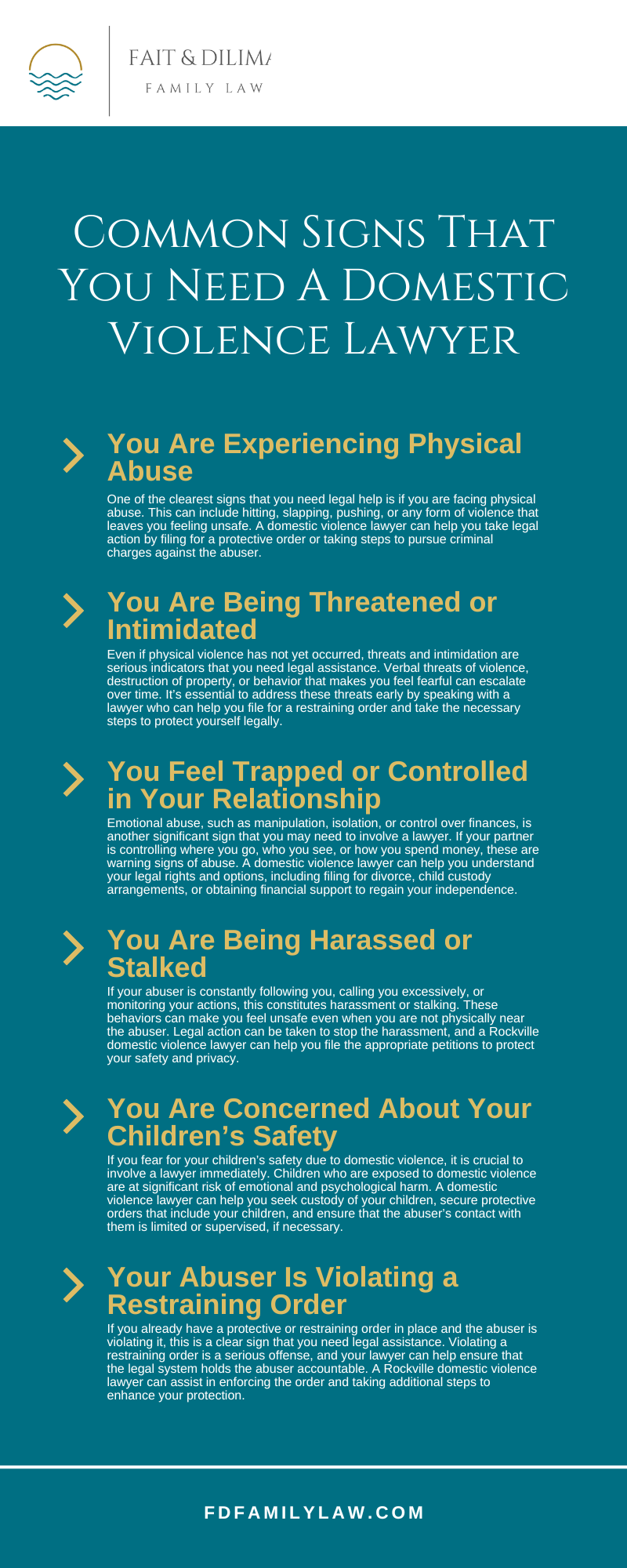
Rockville Domestic Violence Infographic
Why Choose Fait & DiLima Family Law for Domestic Violence Cases in Rockville, MD?
Focused Practice in High-Conflict and Abuse Cases
Certain domestic violence cases in Rockville, MD involve a spouse with a personality disorder. Others involve substance abuse that escalates into violence. Some involve both. Marjorie G. DiLima, Managing Partner of Fait & DiLima Family Law, has built a particular concentration around cases where alcohol and drug use damage family stability, and cases involving narcissists or individuals with high-conflict personalities. That concentration determines how we prepare witnesses, how we structure cross-examination, and how we anticipate the opposing party’s conduct from the first hearing through the last.
Credentials and Recognition
Marjorie graduated with honors in 1994, earning both a J.D. and an M.B.A. She completed a Masters in Taxation at Georgetown University Law and holds a lifetime position in the American Inns of Court. Super Lawyers has recognized her for 10 consecutive years. Best Lawyers named her in 2023 and 2024, and U.S. News & World Report included the firm in its “Best Law Firms” rankings in 2021, 2023, and 2024.
Marjorie received the Bethesda Magazine Top Attorney designation for 2025 and has earned multiple recognitions from the Maryland Bar for her commitment to legal service delivery. She teaches integrity and professionalism to paralegal students at Montgomery College. The firm has a strong record of favorable outcomes in contested custody, protective order, and divorce cases across Montgomery County.
Domestic Violence Case Overview
Legal Definitions, Protective Orders, and Criminal Consequences
Maryland addresses domestic violence through two parallel systems. The civil side provides protective orders. The criminal side imposes penalties for assault, stalking, and related offenses. What happens in one system affects the other. A domestic violence attorney in Rockville must be able to work within both simultaneously.
- Statutory definition of abuse: Family Law §4-501 covers serious bodily harm, threats of imminent harm, assault in any degree, sexual offenses, false imprisonment, stalking, and revenge pornography.
- Person eligible for relief: The statute covers current and former spouses, cohabitants, blood relatives, people who share a child, individuals in a sexual relationship within the past year, and victims of recent sexual offenses. Many survivors do not realize they qualify.
- Protective order stages: Interim orders are issued by a commissioner when courts are closed and last approximately two days. Temporary orders are issued by a judge, lasting up to seven days. Final orders can last up to one year, with six-month extensions available. In cases involving respondents with prior convictions, orders may last up to two years.
- Criminal penalties: Second-degree assault under carries up to 10 years of imprisonment and a $2,500 fine. First-degree assault, sexual offenses, and stalking carry additional penalties.
- Firearm surrender: Maryland law authorizes courts to order respondents to surrender firearms and ammunition as part of a final protective order. Violation of any protective order provision results in mandatory arrest.
Important Aspects in Your Domestic Violence Case
Evidence determines the outcome. That is true in every legal proceeding, but in domestic violence cases, the margin is thinner because hearings happen quickly and preparation time is compressed.
Preserve everything. Text messages in their original thread format. Photographs with metadata showing dates and times. Voicemails saved to a cloud account rather than stored on a phone that the abuser may access. Screenshots of threatening social media posts. Medical records from any treatment, including visits where you did not disclose the true cause of the injury. Police reports, even from incidents that did not result in an arrest. Every piece of evidence that establishes a pattern makes the next piece more powerful.
- At a final protective order hearing, the petitioner must prove abuse by a preponderance of the evidence. That means more likely than not, a lower bar than criminal proceedings require.
- Criminal cases and civil protective orders can proceed at the same time. A conviction is not necessary to obtain a protective order, and a protective order does not require a criminal charge.
- Custody provisions within a protective order are temporary. A separate custody proceeding may be necessary to establish long-term arrangements, and the protective order often influences how the court approaches that decision.
- Children who witness domestic violence are considered affected by it. Courts weigh that exposure when evaluating best interest factors in custody disputes.
Domestic Violence Case Timeline
These cases move faster than almost any other proceeding in family court. The system is designed that way because safety cannot wait for a docket opening three months out.
- Day one: A petition is filed with the District Court clerk during business hours, or with a court commissioner after hours and on weekends. An interim or temporary hearing takes place the same day or the next business day.
- Within seven days: The temporary protective order hearing. A judge reviews the petition and any available evidence, then decides whether to extend protections and schedule a final hearing.
- Within 30 days: The final protective order hearing. Both parties may attend. Both may present witnesses, documents, and testimony. The respondent has the right to cross-examine the petitioner. This is where the case is won or lost.
- If the order is granted: Final orders last up to one year. The petitioner can file for an extension before expiration. Courts may issue orders lasting up to two years when the respondent has prior convictions for violating a protective order.
- Concurrent proceedings: Divorce, custody, child support, and alimony cases may all be underway at the same time. The protective order shapes every one of them.
What to Bring to Your Domestic Violence Consultation
Bring whatever you have. If you left without gathering documents, we can still act. But the more information you provide at your first meeting with a domestic violence lawyer in Rockville, MD, the faster we can file and the stronger the initial petition will be.
- Police reports from any incidents, including those where no charges were filed
- Photographs documenting injuries, property damage, or threatening messages
- Text messages, emails, voicemails, and social media communications from the abuser
- Medical records from any treatment related to abuse
- Names and contact information for anyone who witnessed abuse or its effects
If you are in immediate danger, do not wait for a scheduled appointment. Call Montgomery County Police or go directly to the District Court to file a protective order petition. We can step in to represent you at every hearing that follows.
Maryland Legal Resources for Domestic Violence
State and local agencies provide assistance to domestic violence survivors at every stage of the process, from crisis intervention through long-term safety planning.
- The Maryland Courts website provides petition forms, filing instructions, and information about protective order procedures, eligibility requirements, and hearing schedules across Maryland.
- The Montgomery County Family Justice Center in Rockville offers free services, including help completing protective order petitions, safety planning, counseling referrals, and access to video conference hearings for victims who cannot safely appear in person.
- The National Domestic Violence Hotline provides confidential crisis support around the clock, along with safety planning assistance and referrals to local shelters and service providers.
- The Maryland Child Support Administration assists parents who have separated from an abusive household and need to establish child support for financial stability.
Reach Out to Fait & DiLima Family Law to Schedule a Consultation
If domestic violence is affecting your family in Rockville, MD, Fait & DiLima Family Law is prepared to pursue every available legal remedy on your behalf. We represent survivors across Montgomery County in protective order proceedings, contested custody disputes, and divorce cases where abuse is a factor. Contact our office to schedule a consultation and take the first step toward safety and legal protection.
Contact Us
Ready to take the next step? Complete the form below to connect with Fait & DiLima Family Law.
Locations
Now proudly serving Washington, DC!